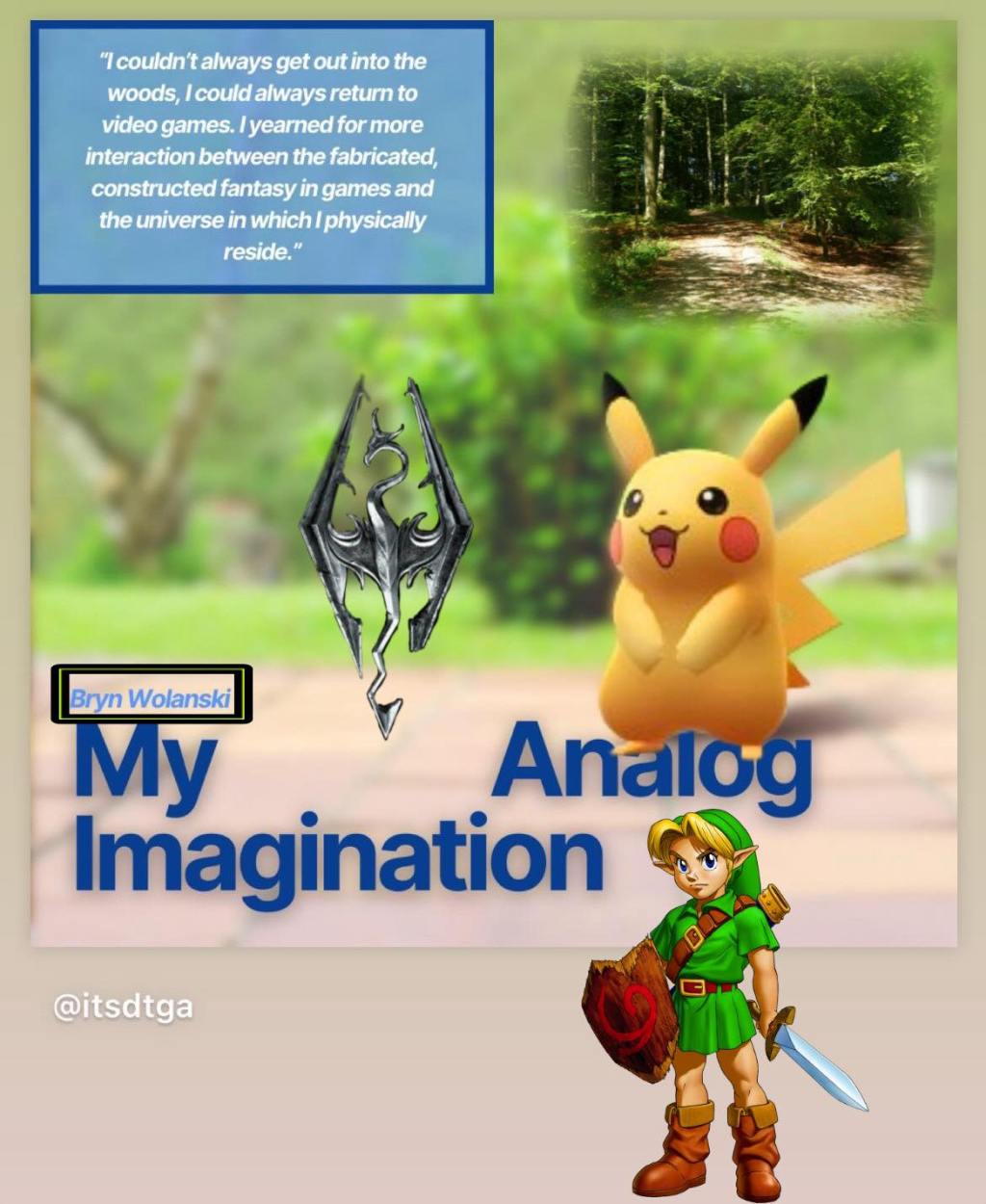
Read the full essay here: https://dangeroustogoalone.site/pokemon-go-imagination/
EDIT: In light of the website shutting down, the full text of the essay is below!
For many people like me, video games can be used as an escape from their everyday lives. Being able to assume the role of a character with a defined purpose and step into a world that is similar (or, sometimes, dissimilar) to their own can be a powerful experience. Although this can be a great catharsis, I always yearned for more interaction, more crossover between the fabricated, constructed fantasy in games and the universe in which I physically reside. In that respect, the release of augmented reality (AR) games like Pokémon Go has been incredibly impactful for others that feel similarly in the gaming community.
I think it’s safe to say that reality has inspired games and given a sense of realism to stories, settings, and characters. I would also argue that games, in turn, have left their mark on reality. You can see this in obvious ways like cosplayers at conventions, dressed as their favorite characters, or in the opening of specialized gaming theme parks across the world. However, I think they’ve left bigger imprints in subtle, unseen, personal ways, for people like me. Games have given me the ability to take ordinary events and make them special, unique, and exciting.
I have always been described as a dreamer. When I was a child, my creativity constantly ran wild. Although I did like playing with my dolls and whatnot, my favorite activity was going outside to play. The outdoors held a sense of wonder for me. There was so much potential for new encounters, new places to explore, and new discoveries. The world was so big and endless and, even back then, I loved the way I felt connected to the earth itself, like I was truly part of the land around me. Even in my suburban neighborhood, the patches of yard that had trees in them felt like the biggest forests, and I would spend hours making “potions” out of berries from my neighbor’s bushes, “houses” out of the tree branches, and losing myself in a land of pure imagination.
As I got older, I, like many other kids, got hooked on the wonderfully nerdy culture of video games. My escapist tendencies of longing for a more adventurous life than my everyday average existence hardly waned. It is not much of a surprise, given my history of playing pretend outside, that I was attracted to games with natural elements in them. For example, playing The Legend of Zelda: Ocarina of Time, in a way, took me back in time to when I was playing in my backyard. My imagination was enthralled with the kingdom of Hyrule, and when I turned the game off for the day, I would head into the yard and engage in play acting out the scenarios I’d left inside on the screen.
The shaded garden at the edge of my family’s property was perfect for getting lost in. I would find a sturdy stick and assume the role of Link, ready to defend my home from Moblins and Peahats as I picked my way through the forest, crossing over intricately interwoven tree roots and moss-carpeted stones. My “sword” gave me comfort as I imagined intense battles unfolding before me, and I could swear I could hear Saria’s Song being carried to me on the wind blowing through the treetops. The woods were magical, fantastical, and felt like home. I had forged a connection between gaming and nature, but I knew that I was the one lending the creativity to make the real and mundane into something magical and special.
When The Elder Scrolls V: Skyrim came out over a decade later in 2011, I was able to assume the role of the protagonist in a way that allowed for more exploration and discovery. Picking flowers and harvesting herbs, climbing up and down hills and mountains… Gaming became a different escape than to fuel play fighting fantasies I’d had as a child. There was now a sense of peace, calmness, and even healing that I was finding in these moments of gameplay (when I wasn’t being chased by a frost troll and running for my under-leveled life). The lines between imagined and actual were still evident, but now there were elements that managed to blur. The real-life walks I would take in the woods turned into a game of its own where I would point out similarities between the landscapes in games and what I was trekking through. Gone were the harsh polygons and finite lines of Zelda, replaced with rolling hills and flowers that blew in coded breezes. I was able to take my time, slow down, and start to enjoy some of the woods for these newer, more fresh ideas that imagination alone couldn’t provide. When outside, the forced break from my everyday surroundings was helpful; I certainly couldn’t “wait” and pass time until something exciting happened. I had to make things happen for myself in those moments, which helped me learn the valuable skills of resilience, time management, and hope. There was a sense of loneliness in these adventures, however. I yearned to share these experiences with others.
It was the 2016 release of Pokémon Go for mobile devices that really changed the game, no pun intended. For the same length of time I’d been playing games, Pokémon and all its franchised iterations had been popular and growing (and continues to do so with no signs of stopping). I wanted to play Pokémon, truly. I had a collection of cards (not that I knew how to play with them, but that first edition holographic Machamp that everyone had was a staple in all nerdy circles). I had played Pokémon Stadium’s mini games to death with my friends. I had owned copies of Pokémon Red, Pokémon Blue, and Pokémon Yellow. I could rap the crap out of the names and knew all the evolutions for the original 151, yet, for the life of me, I could never truly get into the games themselves. I will not type out the numerical confession of how many times I gave up on playing the games before even reaching Pewter City (the number is even smaller for how many times I actually made it out of Mt. Moon).
Pokémon Go was easy to understand and fun, which encouraged newcomers and Pokémon veterans alike (or people who were somewhere in between like me). The first time I downloaded the app, I decided to walk to the park where I was living. Like most games, it was a little buggy at first, but after a few tries, I was floored when I used the AR feature of the game, which used my phone camera, to show me a Caterpie by the swing set ahead of me. Using the AR as a lens, it did what Zelda and Skyrim couldn’t- it bridged the gap between virtual fantasy and physical reality. Of course, Skyrim does have a virtual reality (VR) version, and although that felt immersive for me to play, I wasn’t in the woods of that world, I was still in my office. I could still very much feel the difference. Pokémon Go let me merge the planes of existence rather than finding ways to cross parts over. If I had my phone with me, I would have the option of adventure.
Because Pokémon Go encouraged walking and physical activity, it promoted exploration. With Pokéstops popping up everywhere, it gave players a sense of excitement to visit places they had been before with new eyes or travel to new places to spin Pokéstops, battle gyms, and catch different Pokémon. People would make events to meet at certain places and walk together, friends would go out on Pokémon Go dates, groups online were organized to trade gifts with people even in other countries. I felt motivated to go to different parks in the area, both new and old, which resulted in me being able to share my enthusiasm with others in real time as we played together and made new friendships. Attending meetings at local parks allowed me to encounter other players there for the same purpose: To play games outdoors. I have met several new friends while battling gyms and have cherished that Pokémon Go was able to give me those valuable face-to-face interactions.
While traversing the paths that wound through the woods, I would utilize the AR mode to immerse myself deeper in my own world. With my phone, I could see an Eevee prance into view at my feet while I walked. If I placed my buddy Pokémon at the right angle, I could see it chilling happily on a tree stump. My friends and I would laugh when a Snorlax took up the entire walkway in front of us. Getting lost in the woods had transformed from being a need to become more than just my meager self to me settling into a version of myself that could savor, enjoy, and interact with the world in a new way. After years of wishing for more, I finally had the connections I had been craving.
Not only was this an incredible development in terms of mobile gaming, but the game itself has remained a free app (with in-game purchases available). In previous years, the ownership or rental of a console (handheld or otherwise) was required to play any of the Pokémon games, which meant that there were plenty of people who were often left out. However, today, many people can have a smartphone and download a free app. This meant that Pokémon was accessible for people in an entirely new way that was able to bring them together.
After nearly 10 years since its first release, Pokémon Go has undergone several overhauls, expansions, and updates. It has gone through fluctuations in popularity, but I still thoroughly enjoy it. Heck, I’ve even gotten my husband to play it over the last few years with me when we go for our walks at the various local parks in our area. It’s provided such a great sense of both competition and camaraderie and has been a nice way for us to enjoy each other’s company. It also has helped us from getting turned around in the woods with its detailed maps that will even show the forest trails we’re on! Who needs GPS when you have Pokémon Go?
I’ve even overheard teenagers half my age talking about Pokémon while on my walks, hurrying to attend a nearby raid. Although I sometimes feel a little jealous that younger generations can go on these quests that I only dreamt of at their age, seeing them out in nature, together and having fun, gives me so much hope. Pokémon Go has fostered more meaningful interactions with others, the earth around us, and even ourselves, than I think many people recognize. I think that the game being relevant so many years later is a great indicator that there is still value in the magical way the game blurs the lines of fantasy and reality. It still provides new, fresh ideas to people and helps them become the protagonists of their own campaigns by inspiring them to find something special and exciting amidst their daily grind.
I am so grateful to Pokémon for providing the experiences it has for me. I no longer need to play pretend while living my daydreams. I can become the main character of my own story as it unfolds before my eyes. The intertwining relationship of reality and gaming will continue to evolve, I’m sure, but for now, the days of loading screens between areas are gone. All that’s left is the limitless potential of the future.
For now, as I head into the woods, a cool breeze brings down multicolored leaves from the variety of trees high above me. As the seasons change and a new update for Pokémon Go is released, I find myself excited and ready to continue my storyline of self-discovery.
Now, if you’ll excuse me, I must go tackle the raid that’s about to start. Gotta catch ‘em all, right?



 Inspired by Bryn
Leave a comment